


09 Jun MI-TRAP Air Quality Monitoring Box Tested During Major Vehicle Emissions Campaign in Prague
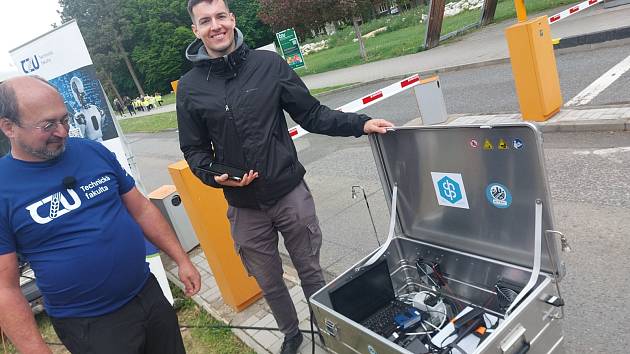
A five-day vehicle emissions measurement campaign took place in Prague in May, bringing together researchers from the Czech University of Life Sciences Prague (CZU), the Czech Academy of Sciences, and the MI-TRAP project to test innovative approaches for identifying high-emitting vehicles in real-world traffic conditions.
The campaign was conducted at the main entrance of the CZU campus in Prague-Suchdol and combined laboratory-grade instruments, portable monitoring equipment, and the MI-TRAP air quality monitoring box. Researchers assessed vehicle emissions under everyday driving conditions, generating a valuable dataset for evaluating low-cost monitoring solutions capable of detecting vehicles with malfunctioning emissions control systems.
According to the research team, initial observations indicate that the campaign produced some of the highest-quality measurements collected so far.
Detecting High-Emitting Vehicles in Real Time
A key objective of the campaign was to evaluate methods for identifying vehicles that contribute disproportionately to urban air pollution. While only a small percentage of vehicles may have serious emissions problems, these vehicles can account for a significant share of harmful pollutants released into the atmosphere.
Researchers tested a remote sensing system capable of analysing vehicle exhaust emissions within seconds as vehicles passed through the campus entrance. The system can help identify vehicles with missing particulate filters, malfunctioning catalytic converters, or other technical issues affecting emissions performance.
The measurements are intended as a screening tool rather than a replacement for official emissions testing. However, they demonstrate the potential for rapid identification of vehicles that may require further inspection.
The Role of the MI-TRAP Monitoring Box
Alongside the remote sensing equipment, researchers deployed the MI-TRAP monitoring box, a low-cost air quality monitoring device developed within the project to support the detection and assessment of transport-related pollution.
The MI-TRAP boxes are being tested across several European cities and are designed to monitor emissions from different transport modes, including road traffic, aviation and shipping. In Prague, the research team explored whether roadside measurements could help identify high-emitting vehicles by analysing air samples collected near the road rather than directly from exhaust plumes.
The campaign provided an opportunity to compare measurements from the MI-TRAP box with more advanced monitoring instruments and assess its effectiveness as a scalable and affordable monitoring solution.
Supporting Cleaner Urban Mobility
The findings contribute to MI-TRAP’s broader objective of developing innovative tools and methodologies to better understand and reduce transport-related air pollution in urban environments.
Future applications of this research could include the deployment of low-cost monitoring devices in sensitive urban locations such as school zones, city centres, and other areas where air quality has a direct impact on public health. By supporting the identification of high-emitting vehicles, these technologies could help cities design more targeted and effective air quality management strategies.
Media Coverage
The Prague campaign attracted significant national media attention in the Czech Republic. The work was featured on Czech National Television’s evening news programme and in the national newspaper Deník, highlighting growing public interest in innovative approaches to tackling transport emissions and improving urban air quality.