


30 Oct Hourly predictions of ultrafine particles and noise in the MI-TRAP pilot cities using machine learning
Ultrafine particles are airborne particles below 100 nanometres in diameter. They come mainly from combustion and road traffic, they occur in very high numbers, and they are still neither regulated nor part of routine air quality monitoring [1]. The evidence base on their long-term health effects has grown substantially over the past decade, although independent effects remain hard to separate from those of other pollutants [1]. Their concentrations also change sharply from one street to the next, which makes exposure difficult to estimate without fine-scale data.
Environmental noise is the other major traffic-related exposure in cities. Long-term exposure to transportation noise is associated with ischaemic heart disease, heart failure, and stroke, and night-time noise fragments sleep and raises stress hormone levels [2].
Both exposures vary by the hour and by the street, which annual average maps cannot capture. Operational predictions that run every hour can, and that is what makes them useful for exposure assessment, for short-term health studies, and for local measures that need to act on the right street at the right time.
In MI-TRAP we are developing operational hourly predictions of ultrafine particles and noise across the ten pilot cities. The predictions are produced by machine learning models trained on local measurements and driven hourly by traffic, meteorology, street geometry, and satellite-derived land cover. Copenhagen, Athens, and Lisbon are what we call the data-rich cities in the project, with measurement records long enough to train the models directly. For the seven data-scarce cities, including Florence, Milan, Lille, Rotterdam, and Prague, the models will be extended using transfer learning.
Copenhagen is the most developed case, with preliminary results showing hourly correlations around 0.65 and daily correlations around 0.92 against independent measurements.
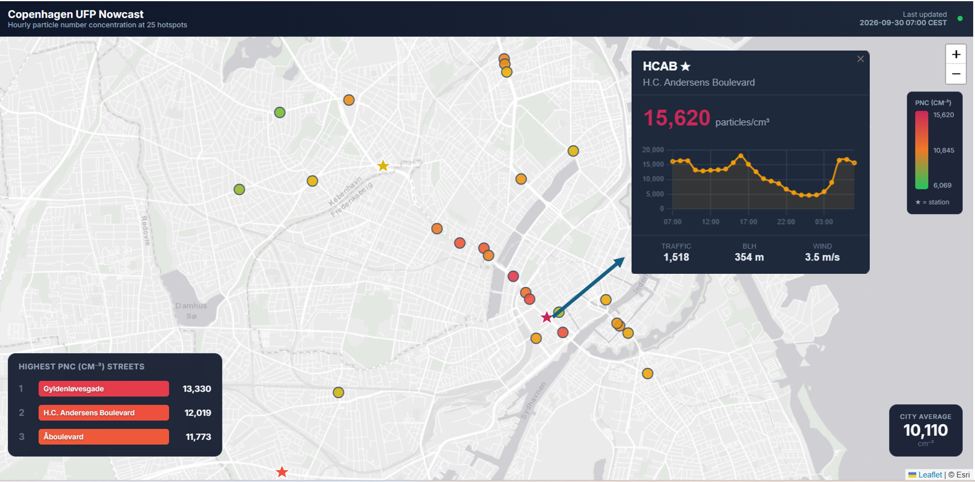
Example of operational hourly UFP predictions for Copenhagen.
This is ongoing work. The full methodology and results will be presented in forthcoming publications, and an official public MI-TRAP visualisation dashboard and toolbox is planned for next year.
For more information about this work, please contact Jibran Khan, who leads the ultrafine particle and noise modelling in MI-TRAP, at jk.envs@gmail.com.
References
[1] Bergmann, M., Haddad-Thoelke, P., Jeong, H., et al. (2026). Systematic review and meta-analysis on the health effects of long-term exposure to ultrafine particles. European Respiratory Review, 35(179), 250156. https://doi.org/10.1183/16000617.0156-2025
[2] Münzel, T., Molitor, M., Kuntić, M., et al. (2024). Transportation noise pollution and cardiovascular health. Circulation Research, 134(9), 1113-1135. https://doi.org/10.1161/CIRCRESAHA.123.323584.